
Musashi Miyamoto
A conversation about Mastery

The most famous samurai in all history was a man named Musashi Miyamoto.
He was born 1584 and lived to 1645. If you ever see a video about him the thumbnail will almost certainly look like this:
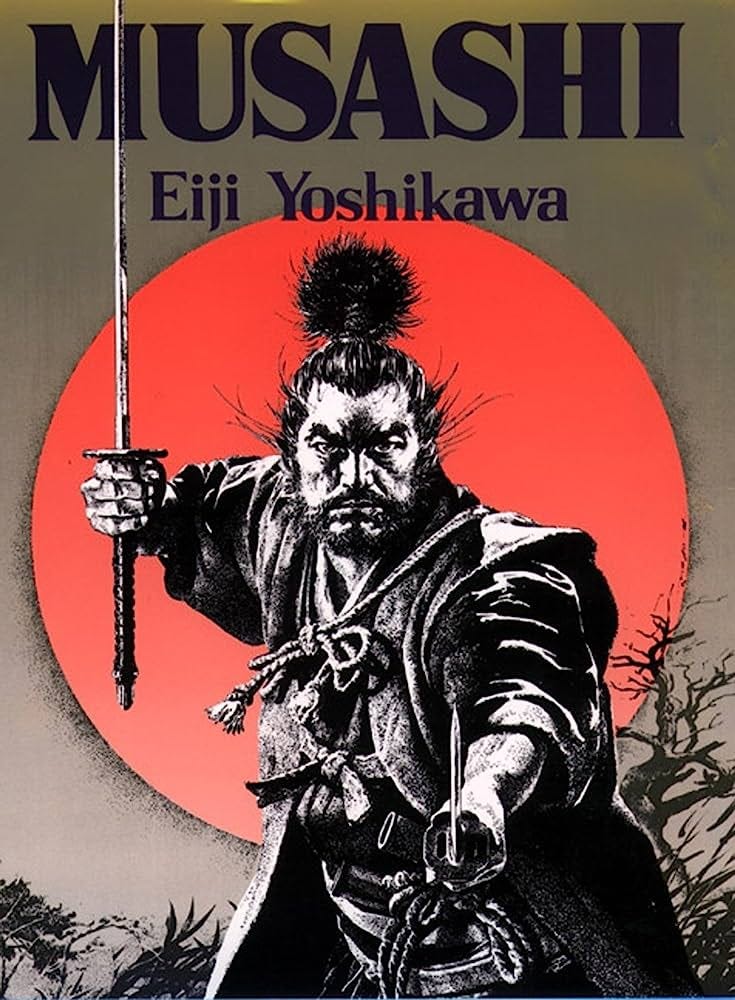
Which is from Eiji Yoshikawa’s depiction of Musashi.
Or this
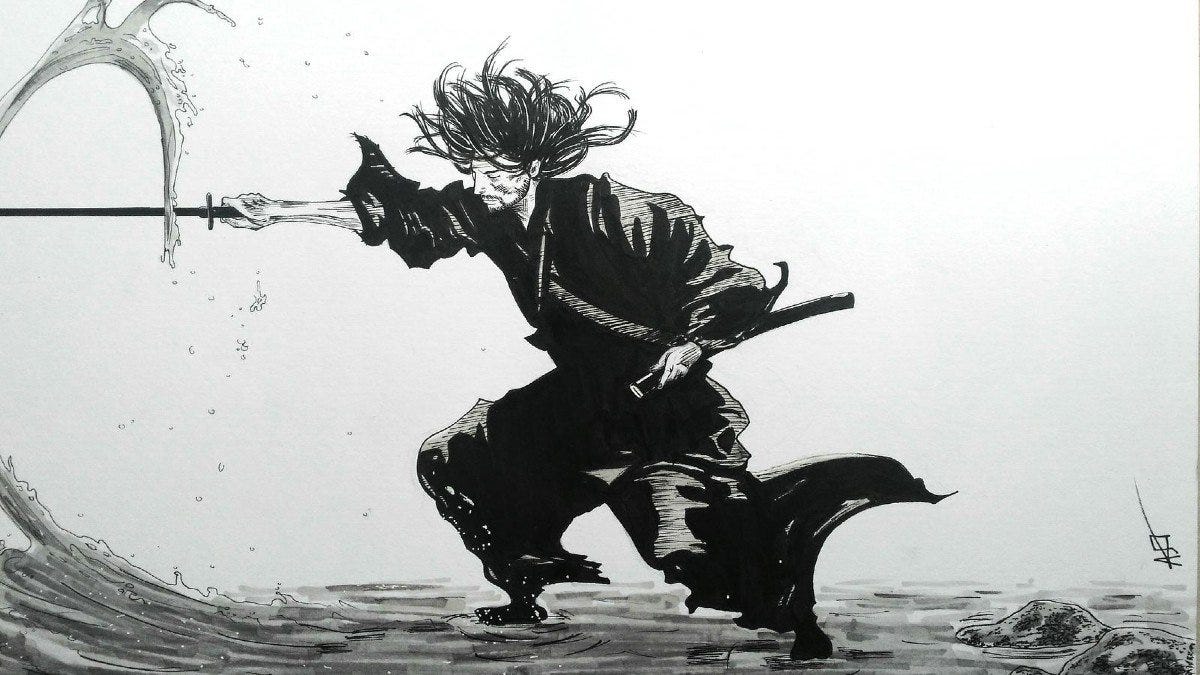
Which is from Takahiko Inoue’s Vagabond Manga, an adaptation of the story of Yoshikawa’s Musashi.
But Musashi actually was a painter in his old and age drew himself like this:
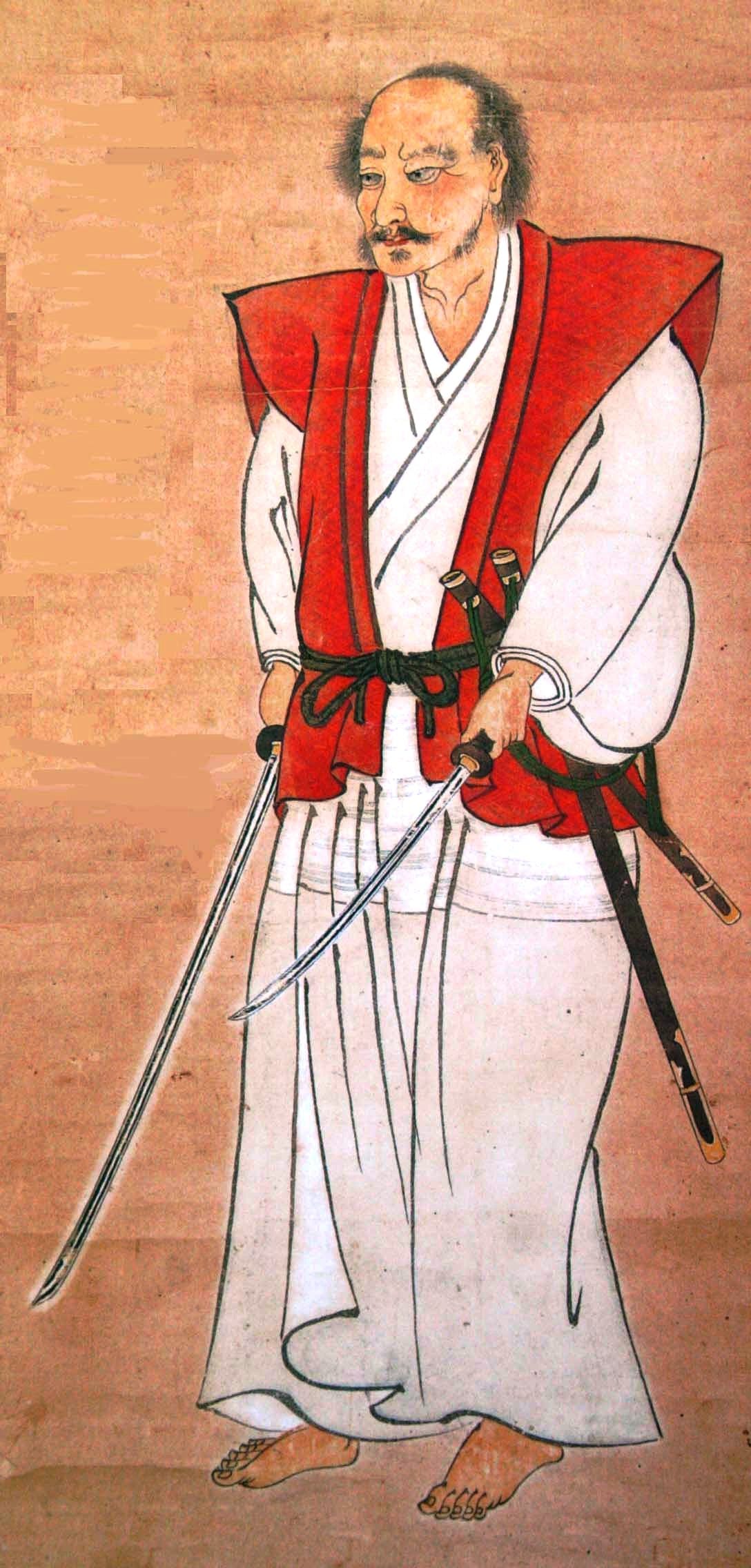
He’s famous for being the greatest Rōnin samurai to have ever lived. According to his own account of his life he won over 60 one-on-one duels to the death.
The second highest was a man named Ito Ittosai who won around 50 duels. Ittosai may have lived at the same time as Musashi too, but there are, unfortunately, no records of them ever meeting. Ittosai was said to float on driftwood to an island village. He then saved it from bandits and began training. He had a famous “Musoken” technique wherein he emphasized moving unconsciously and effortlessly. Ittosai would travel around Japan wearing a sign that said he was the greatest swordsmen alive and then cut down anyone who challenged him. His master was a man named Kanemaki Jisai, who also may have trained Sasaki Kojiro, the man who is now seen as Musashi Miyamoto’s greatest rival.
Here’s the quick summary of Musashi’s life:
At age 13 he wins his first duel, killing a traveling samurai, named Arima Kihei, who was much older then him. He travels to Tokyo where the Yoshioka clan of sword training reigns. Musashi’s father was a man named Munisai who was an expert in the Jitte and had challenged the Yoshioka clan in his past, which may have been responsible for Musashi’s choice to go to Tokyo (Though Musashi was raised by his uncle). While there he kills the Yoshioka clan head, Seijuro Yoshioka, in a duel in the streets, violently beating Seijuro with his wooden sword after he was down. As a result Denshichiro, the brother of Seijuro and second in charge, challenged Musashi to a duel. Musashi kills him as well, deliberately showing up late to the duel (an intentional tactic that Musashi repeatedly used to anger his opponents and one which he talks about in his book). The Yoshioka clan, in response to losing their two heads, has the youngest brother, a twelve-year-old named Matasichiro, challenge Musashi. Musashi, however, shows up early to the duel and hides in the bushes, where he sees the youngest Yoshioka come in full armor with an entourage of armed guards. Musashi assassinates the youngest Yoshioka and then pulled his second sword out to help him carve a path out from the entourage and escape.
After his encounter with the Yoshioka, he began traveling around Japan to learn more about the art of swordsmanship. The highlights of this include his encountering a man who had mastered the kusarigama, a sickle and chain weapon. Another encounter tells of Musashi combatting a lord and driving him up a set of stairs before using his “Fire and Stones cut” to split the lord’s blade in half. He then spent a few years as a teacher to that very same lord.
His most famous battle comes at age 29 year against Sasaki Kojiro. Sasaki Kojiro was a famous local teacher of swordsmanship. He had a sword so long it was named the monohoshizao, literally meaning the “Laundry-drying pole”, for its length. Its blade was about 3 feet long whereas a traditional Katana was about 2 feet 3 inches long. Samurai also carried a shorter sword called the Wakizashi, which was between 1 and 2 feet long. But actually, Kojiro’s sword was a nodachi, not a Katana, and the average length for a nodachi was quite similar to Kojiro’s 3-foot-long monohoshizao.
Kojiro also had a “special move” called the Tsubame Gaeshi, or the “Swallow’s cut” or “Swallow’s Reversal”. Some sources claim it was named because he could cut a swallow out of the air it was so fast, but more credible sources say it was because the movement looked like a swallow’s tail. The movement involved bringing the nodachi down in a big swing and then quickly flipping the sword around and using the big swing as a feint to cut them up from the groin to the chin. It’s easy to imagine how this could be effective, a less experienced opponent might struggle with a big swing from a nodachi alone and a more experienced opponent might think they have a free opening once they have dodged the downswing of such a large weapon.
The story goes that Musashi is the one to challenge Kojiro to a fight and they agree to a duel in the morning on the island of Ganryu-Jima. Both Musashi and Kojiro were monsters by the way. Musashi was said to be about 5’11” and Kojiro about 5’10”. This was much larger than the average 1600s Japanese man, which is estimated to have been about 5’1”. Musashi shows up late to the duel, as usual, and on the boat ride over, according to legend, carves his sword from the spare oar at the bottom of the boat. When Musashi arrives, Kojiro is mad that Musashi has dishonorably shown up so late and he throws his sword’s sheath into the ocean. At the time that was a gesture between samurai to mean “This will be a duel to the death”, i.e. “I won’t be sheathing my sword this duel”. To which Musashi responded something along the lines of “You won’t be needing that anymore anyways”.
There are a number of ways the fight is said to have gone. Some say Musashi used the wood sword, some say he used his signature two swords (He almost certainly didn’t use two swords in the fight, he only really did that against multiple opponents). Some say Kojiro cut off Musashi’s headband or a towel around Musashi’s head and Musashi was able to bash Kojiro’s head in after. Some have also said that Musashi was able to maneuver Kojiro to face the sun and the sun blinding Kojiro gave Musashi his lethal opening. That’d seem unlikely, but Musashi teaches that sort of maneuvering in his book. One way or another, Musashi kills Kojiro.
After the battle of Kojiro, stops engaging in duels, or at least he has no more major duels. He does go back into combat at the battle of Osaka Castle. Some say he had some small group defend a bridge against some legendarily large number of attackers with Musashi cutting down multitudes and switching weapons as he did in an extremely cinematic fashion. As far as I can tell, there is a record of him being in the battle, and if he was then he may have defended a bridge, but there aren’t extensive records of his actions there. Similarly, there is a common notion that at sixteen he was involved in the Battle of Sekigahara, which was the final battle of the long war which unified Japan. In Eiji Yoshikawa’s book Musashi he fights for the losing side and now youtube videos like to edit in epic music as a narrator says “Musashi managed to survive the battle of Sekigahara despite fighting for the losing side…”. Musashi did not fight at the battle of Sekighara, though he may have been at a different battle at the time. Its especially unlikely he would have fought for the losing western side of Sekigahara, seeing as he fights for Ieyasu’s supporters (The eastern, winning side) at the Siege of Osaka.
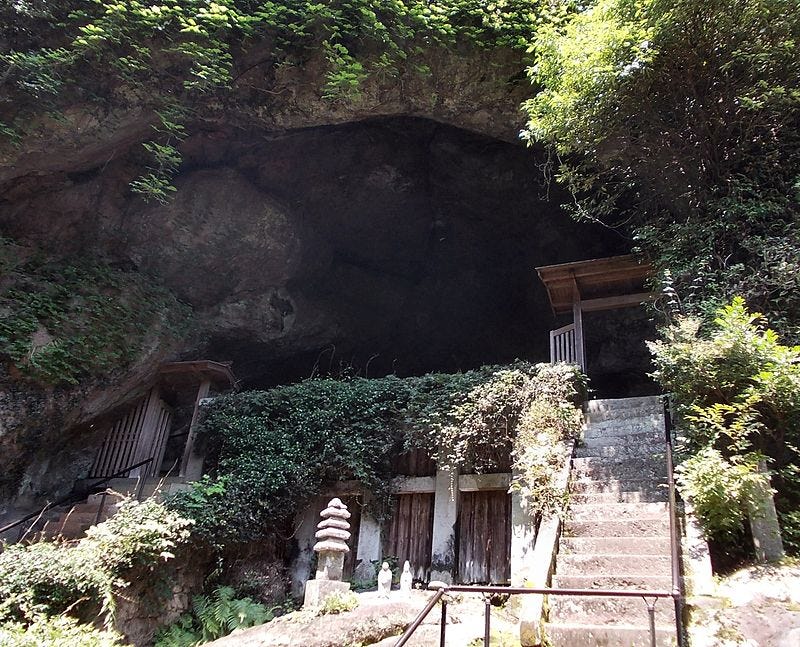
The rest of Musashi’s life is mostly spent teaching. He opens a school of “Niten Ichi-ryū”, loosely translating to “The School of Two Heavens as One”, it was a school of swordsmanship specializing in dual wielding. He may have also taught shuriken throwing for a time. In his older age, he practiced painting and other arts and retired to a cave called Reigando, pictured below, where he wrote his famous Go Rin no Sho, or Book of the Five Rings, as a strategy guide for one of his disciples. Then he writes down the Dokkōdō, a book of 21 precepts for the warrior. A week later he dies of cancer at about 60 years old.
The rest of this post is devoted more to Musashi’s book, his philosophy, and his legacy.
His Book of the Five Rings is divided into 5 chapters, each of which named after an element. The five are Ground, Water, Tradition (Wind), Fire, and Void.
Ground
It is difficult to realise the true Way just through sword-fencing. Know
the smallest things and the biggest things, the shallowest things and the deepest things.
The book of Ground is devoted to the idea that the way of Strategy transcends the sword. That there is something deeper behind mastery connecting all things together.
One of my favorite parts about the Book of the Five Rings is that it includes Musashi’s opinions about combat fads and a sort of “meta-analysis” of lethal man-to-man combat. That should be obvious, seeing as it’s a strategy guide. I’ll talk about it later though, but often Musashi’s legacy doesn’t often discuss these elements of his book.
The book of Ground breaks down Musashi’s analysis of weapons of the time:
He wields a sword with one hand because if you wield it with two you limit your movement.
He thinks the halberd is inferior to the spear as the halberd is too defensive and gives the initiative to the more aggressive spear. But he finds both to be field weapons that don’t have the versatility to be used indoors.
He thinks the bow is a dying art in his day as it can shoot fast but is weak in a siege and has limited range. He praises the gun as the “supreme weapon” within fortifications, with no peer until the enemy gets into range with a sword, at which point it becomes useless.
He says arrows are nice because you can see and correct your aim with them, whereas that’s not possible with guns.
Nevertheless, he thinks all the weapons in his time have pros and cons and no warrior should have personal preferences, rather, they should just wield the proper weapon for their situation rather than using the wrong weapon on account of preference.
Musashi also advises that there is timing in everything which determines strategy. Shooting an arrow is as much a matter of learning Timing as a merchant learning the ebbs and flows of capital. He believes timing is the key to all elements of his book.
Water
If you master the principles of sword-fencing, when you freely beat one man, you beat any man in the world. The spirit of defeating a man is the same for ten million men... The principle of strategy is having one
thing, to know ten thousand things.
For both the water and fire books I’ll make a bit of an abbreviated summary as each book contains very specific swordsmanship techniques. For instance, he talks about the “Red Leaves Cut” or the “Glue and Lacquer Emulsion Body”. The first is a method of beating the opponent’s sword down and out of their hands, and the second is a discussion of getting into opponents and then sticking to them.
Musashi also talks about combat against multiple opponents, which was the only case in which he used two swords. Confusingly he also uses the phrase “two swords” to mean “using all your resources”. In Musashi’s view, it was stupid for someone to die with a trick or weapon still up their sleeve. So, for example, he criticizes the idea of a Samurai carrying a Wakizashi and then never using it. He thinks they should at least throw it at their opponent.
Fire
This is another book that is dominated by very specific tactics and ideas to swordsmanship which I won’t discuss. Present throughout it is a discussion of “spirit” in combat. I think Musashi’s take is similar to Roger Federer’s idea of “Fire and Ice” which he talks about here:
Finding focus while maintaining adrenaline and strength.
There is also a discussion of
Tradition (Wind)
This, to me, is the most interesting chapter of the book as it’s Musashi’s discussion of other swordsmanship traditions and commonly held beliefs.
For instance, Musashi talks about there being schools of people who hold that the long sword is better or that the short sword is supreme on account of length or weight respectively. Musashi thinks these are views that are contradictory to strategy, you can’t have a preference because there are circumstances for each. Moreover, Musashi seems to believe that if you are the better swordsmen then the sword won’t be the difference, which would explain Musashi using a wooden bokken in duels.
Musashi also speaks of a habit of swordsmen parrying or dodging a strike and then retreating back. Some swordsmen in Musashi’s time do this habitually according to him, which he believes is weak. Doing or believing anything habitually is weak in Musashi’s eyes. Particularly the habit of retreating is weak according to Musashi because it allows the aggressor to chase them around and “control their spirit”. It permanently grants the aggressor the initiative.
Void
This book is by far the shortest and can accurately be summarized by this set of quotes:
What is called the spirit of the void is where there is nothing. It is not included in
man's knowledge. Of course the void is nothingness. By knowing things that exist, you
can know that which does not exist. That is the void.

People in this world look at things mistakenly, and think that what they do not
understand must be the void. This is not the true void. It is bewilderment.
My favorite part of that quote is that he says “People in this world…”, I’m sure it’s just something that comes from translation but it’s such a grand way of phrasing that.
Dokkōdō
I won’t go over all of the 21 precepts of the Dokkōdō, if you want you can read them all here. The Dokkōdō is very Buddhist and talks about the “Path of Aloneness”. It talks about renouncing pleasure, never feeling jealousy, don’t have preferences (a very Musashi theme), doesn’t have regrets, etc.
Legacy and Commentary
First off, I’m just going to throw out some common Musashi quotes that come up a lot.
“Anyone can give up, it’s the easiest thing in the world to do. But to hold it together when everyone else would understand if you fell apart, that’s true strength.”
“You must understand that there is more than one path to the top of the mountain”
“Perception is strong and sight weak. In strategy, it is important to see distant things as if they were close and to take a distanced view of close things.”
“Think lightly of yourself and deeply of the world.”
His book is also filled with phrases such as “This will be difficult, but everything is difficult at first” or recurrently saying “Think carefully on this”.
I often wonder if Musashi would be a fan of the people who admire him nowadays. Or if any philosopher would be happy with their fans.
I know a guy who inhabits the same Discord channel as my friends. Every so often he’ll say things in the messages like “Just had a cutie flirt with me at the supermarket”. Or “There are so many cuties out today”. He likes to take selfies at group gatherings and does the duck face, I think unironically. And recently he posted a picture of a stack of books he bought along with the amazon order of three more that were coming. It was like 7 books on Stoicism including Marcus Aurelius’ Meditations. I can’t help but think it’s antithetical to stoic philosophy to tout how you’ve just bought a bunch of books on stoic philosophy. I once went to a Banksy exhibit all about being anti-consumerist and so forth. The entry price was 50$ a person and people were lined up at the gift shop at the end.
And so Musashi’s legacy seems the same, zealots obsessed with the vibe of Musashi’s mastery and wisdom to the point where they can’t even see it.
I’ve found it funny to think deeply about the idea of Mastery as well, fleeting as it might be. You might spend your whole life as a swordsman attempting to reach the very pinnacle of man’s ability. And everyone you meet who is better than you you see as another stepping stone to that end. But say you make it? How could you see yourself then as anything other than another stepping stone for someone else? And then how can you value mastery but not the masters?
The truth of the matter, so far as I can see, is that there is supposed to be an underlying emotional mastery that justifies all the training and turbulence, and strategy. Unfortunately, it’s not as simple as “If you get swole, then you’ll be enlightened”. Nevertheless, that’s the vibe.
Often I wonder if I really know what self-mastery looks like. I don’t think it means being able to run until kidney failure in a David Goggins-style mental fortitude test. Surely it means something though. Antithetically to the “Martial enlightenment” idea, many of the fitness gurus and “mental toughness” “Become the Monster” I’ve seen fuel their drive with ego and pride or some delusional sense of society or the value of their fitness. This, I think, is where balance comes in. Knowing the deepest things and the shallowest things, as Musashi would have it.
Again though, I don’t know that I know what self-mastery looks like anyways. Suppose you entered some cafe one day and there was an old man drinking coffee and for some reason, you approach him. Every sentence he speaks is punctuated with the sound of some distant gong. You feel compelled to tell him about your problems and he responds with a vaguely related but inspiring-sounding anecdote about Buddha and a ferry. Even then would I recognize that I was in conversation with someone with self-mastery?
That’s another thing. I don’t like the idea of old people being enlightened. I’ve
mentioned this in another post, but I don’t like the idea that someday I’ll age out of my problems. It seems to me that the “Just don’t have attachments” view of self-mastery is a copout, as standard as it is. Maybe it minimizes pain, but by that definition, we might as well start calling every rock in the forest “Great and wise sage” because they don’t have any attachments at all, except to moss.
I, of course, don’t have answers to any of what I say. If there were some objective answers maybe Musashi wouldn’t have to talk about a path of “aloneness”. In the words of Eiji Yoshikawa, “The world is always full of the sound of waves”.
P.S.
There’s a subscribe button hidden in every header of the article if you want that too.